A Market Morning, Read Through Its Small Rituals
Learn how to read a market morning by noticing stall routines, queues, and browsing cues, so you can shop or observe without interrupting the flow.
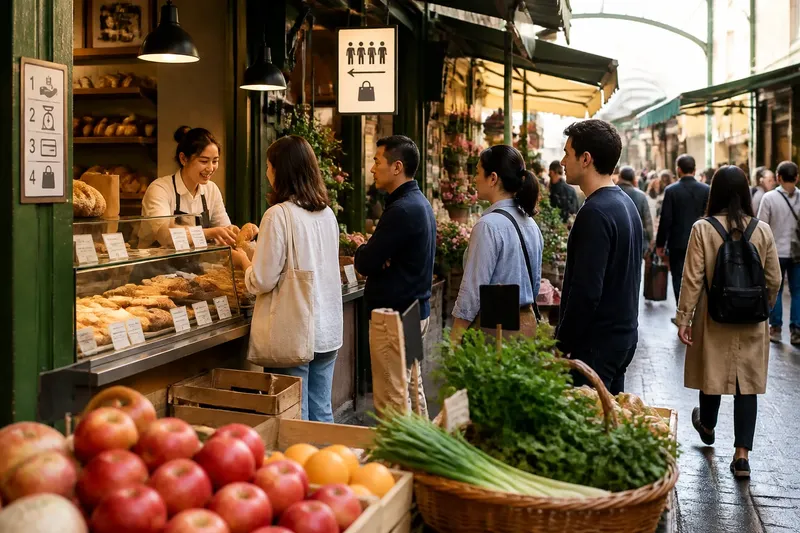
How do you read a market morning without turning other people’s errands into a show? To read a market morning, focus on how stalls handle orders, payment, and waiting—not on guessing who knows whom. These small systems reveal how the market works while giving you practical cues for browsing respectfully.
Read a market morning through its working routines
Begin with the transactions. At one counter, customers may point to goods while the seller selects them; elsewhere, shoppers may pick items themselves and bring them to a scale. Notice the sequence before joining in, especially if the stall has a line or a shared serving space.
Look for signs that explain the process: handwritten labels, numbered tickets, a separate place to pay, or a marked pickup point. Such details are more useful than trying to interpret a stranger’s expression or conversation. If a sign is unclear, wait for a natural opening and ask a short, specific question.
Market customs vary, even between nearby stalls. Treat what you see as a local procedure for that counter, not a rule that applies everywhere.
Choose a route around the market’s layout
A purposeful route works well when you need particular goods. Keep your list ready, locate the relevant stalls, and leave room to adjust if a line runs into an aisle. A broad wander is better suited to learning the market’s layout: follow the edges of busy passages and pause where people can pass.
Pay attention to how different stalls organize space. A bakery may have a queue that bends along a wall, while a produce stand may serve customers from either side. Do not assume that the most open-looking counter has no line; watch where arriving shoppers wait and how the seller acknowledges them.
Say you enter with a short list for breakfast: bread, apples, and cheese. You see customers waiting beside the bakery rather than in front of it, so you join at the back, order bread, and move to the side to check the next stall’s setup. The observable result is a clear place in the queue and an unobstructed route for other shoppers; if the bakery’s arrangement remains unclear, you can ask where the line begins before ordering.
Follow the stall’s cues when greeting and asking
A brief hello or nod is enough to acknowledge a seller. If someone is already being served, wait until that exchange ends rather than calling across the counter. When your turn comes, a direct question such as “How is this usually prepared?” invites an answer without requiring a long conversation.
Browsing without buying may be welcome at some stalls and awkward at others, particularly where space is tight. Watch whether customers handle goods themselves or point while the seller selects them. If the practice is not clear, keep your hands back and ask before touching food or merchandise.
If the counter is busy, keep questions focused and give the seller room to continue serving others. A short answer is still a useful answer.
Use these market cues to decide what to do
- If a line forms beside the counter, join at its end; if customers instead wait in a marked pickup area, use that spot.
- If a sign says to select goods yourself, choose from the display; if the sign says to ask, wait for the seller to serve you.
- If customers place purchases on a scale, do the same when your turn comes; if the seller weighs each order, keep your goods off the scale until asked.
- If the payment point is separate from the ordering counter, carry your order there after serving; if payment happens at the counter, remain until the seller completes the transaction.
- If the aisle narrows near a stall, step aside before checking your list or phone; if a clear standing area is available, use it without blocking the queue.
- If shoppers are passing through a doorway, keep your bag or cart close and move beyond the entrance to pause; if the doorway is clear, avoid lingering there anyway so the route stays open.
These observations make decisions easier without requiring you to copy every gesture. When the arrangement remains uncertain, a courteous question is more useful than a guess.
What do visitors ask about market etiquette?
Can I browse a market without buying anything?
Often, yes, but it depends on the stall and how crowded it is. Browse from the aisle where possible, avoid handling goods without permission, and move aside if customers are waiting.
Should I ask before taking a photograph?
Ask the seller before photographing a stall, especially if the picture would include workers or customers. If the seller declines or seems unsure, put the camera away and continue without pressing.
How can I tell where a queue starts?
Watch where newly arriving customers stand and where the seller directs them. If no pattern is visible, ask, “Where should I wait?” before stepping into the serving area.
What should I do if I make an etiquette mistake?
Stop, offer a brief apology, and follow the seller’s direction. A small correction is usually more helpful than a lengthy explanation that holds up the line.
Notice the market without turning people into a spectacle
Details such as a ticket system, a separate payment spot, or a familiar order of service tell you more about the market’s organization than speculation about individual shoppers. If you want to remember what you saw, note the layout or procedure after leaving, without recording identifying details about strangers.
Reading a market morning is most useful when it helps you take part with less guesswork. Before leaving, check that you have your purchases and step clear of the entrance; next time, you will know which cues to look for and where to pause.